

How does it work?
This is not magic, it's the future of strategy games
How the engine thinks
Multi-agent architecture
Seven cooperating agents plan in parallel: Negotiation & Trade, Microeconomy, Macroeconomy, Spatial & Relations, Investment, Social Policy, and Conflict. Each agent proposes actions with a score and a rationale.
Decision loop:
- Read state: economy, map, inventories, relations, policies, events.
- Each agent simulates short scenarios against constraints and uncertainty.
- Agents post proposals to a shared board with scores and reasons.
- A coordinator resolves conflicts and selects the final action set.
- Engine writes decisions and trace data for explainability.
Inputs used:
- Current state
- Telemetry
- Scenario params
Outputs:
- Actions per agent
- Updated state deltas
- Human-readable decision traces
Tuning and balance
All weights, caps, and guardrails are configurable per project and per difficulty. You can dial realism, pace, volatility, and challenge
Explainability
Every decision writes a trace: inputs used, weights, guardrails hit, and alternative options that were considered but rejected.
Negotiation & Trade
What it does
Sets offers and counteroffers for commodity and service deals. Prices respond to cost anchors, relationship quality, and willingness to trade. A safety floor prevents irrationally cheap outcomes. Quantity caps respect stock and logistics.
Inputs used
- Production cost and reference prices
- Relations and opinion memory
- Willingness to trade (opinion driven)
- Regional stock and deal caps
Outputs
- Price corridor and chosen deal price
- Max deal quantity and accepted quantity
- Regional stock and deal caps
Flow at a glance
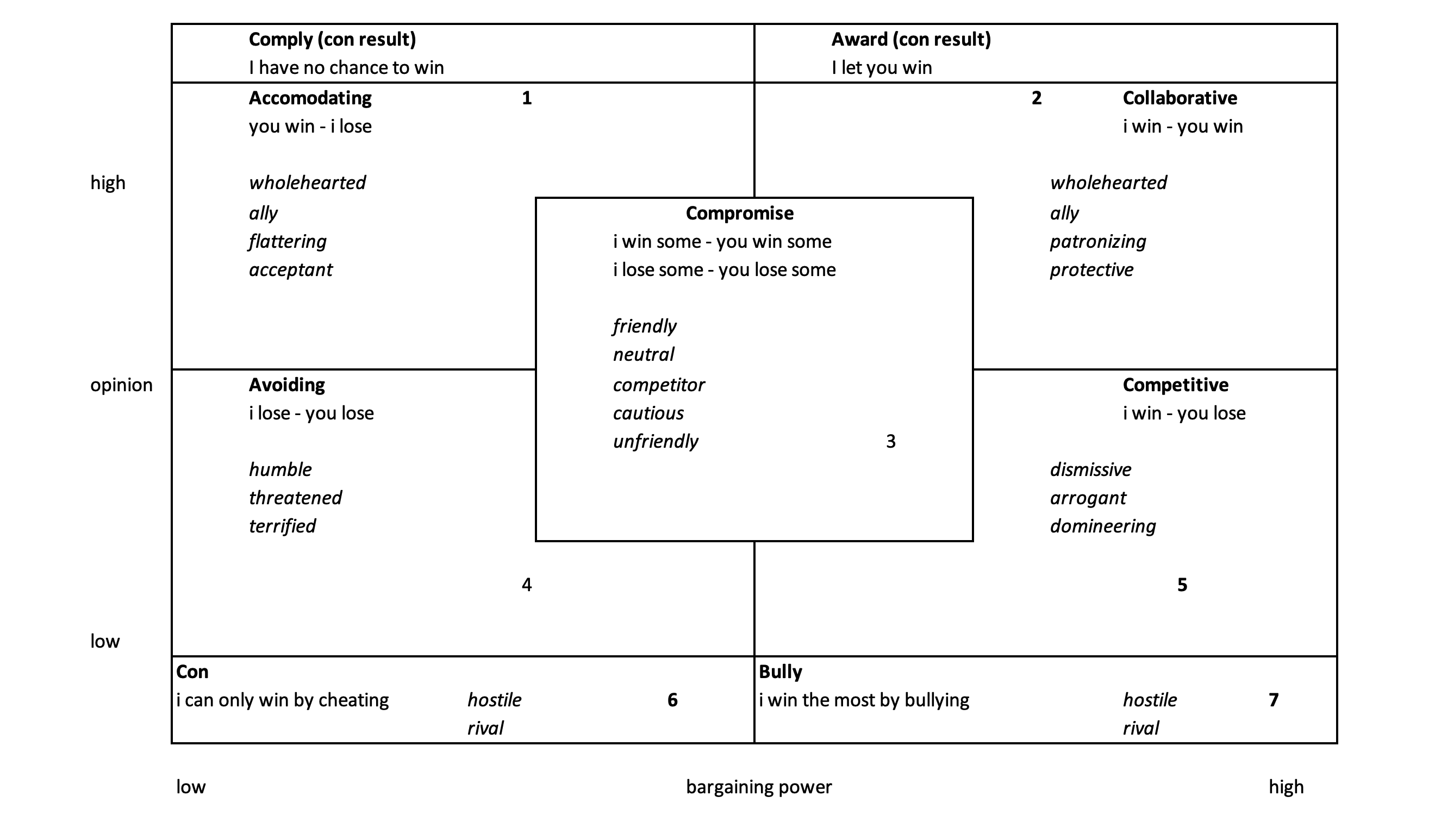
Opinions feed goodwill which maps to willingness. Relations adjust the corridor. Cost sets the anchor. A floor keeps prices realistic. Stock sets the quantity cap.
| Determinant | What it is | Time behavior | Website note |
|---|---|---|---|
| Production Cost (PCC) | Baseline unit cost of the traded commodity. | Updates when production tech or inputs change. | Cost‑anchored pricing: realism tied to actual production costs. |
| Relationship Quality (DRM) | Overall diplomatic relations between the two sides. | Evolves with actions, treaties, conflicts. | Relationships matter: goodwill earns concessions. |
| Willingness to Trade (TWC) | Propensity to trade given current goodwill. | Responds to accumulated goodwill signals. | Negotiations with memory: past choices shape current deals. |
| Their Opinion of Us (TOU) | Counterparty’s sentiment toward the player. | Updates after interactions, trades, conflicts. | Favors earned through behavior reduce prices over time. |
| Our Opinion of Them (OOT) | Player’s sentiment toward the counterparty. | Updates with history of dealings. | Reciprocity: mutual opinions steer outcomes. |
| Price Guardrail | Configured minimum bound linked to cost. | Static unless reconfigured by designers. | Prevents ‘unrealistic bargains’ while keeping deals fair. |
| Benchmark Anchors | Fair‑trade reference & recent average prices. | Rolls with recent trading history. | Market‑aware: players see prices that make sense in context. |
Microeconomy
What it does
Optimizes price and quantity under equilibrium and under rationing. The agent works with a discrete price ladder and simulates quantity response, revenue, costs, and profit under three market states: equilibrium, demand shortage, supply shortage.
Inputs used
- Price step grid and elasticity band
- Capacity and split between actors
- Cost structure by source
Outputs
- Selected price step and target supply
- Expected revenue, cost, profit
- Unmet demand or surplus carried into the next turn
Design notes
- Short-side rule in shortages keeps outcomes believable.
- Promotions shift demand rather than hiding price moves.
- Sensitivity is re-estimated from recent turns for stability
| Determinant | What it is | Time behavior | Website note |
|---|---|---|---|
| Market state (equilibrium vs. demand/supply disequilibrium) | AI classifies the market each turn: equilibrium, demand‑shortage (‘nierównowaga popytowa’) or supply‑shortage (‘nierównowaga podażowa’). | Re‑evaluated every turn as demand/supply and prices update. | The engine reasons under rationing — decisions differ when demand exceeds supply vs. the opposite. |
| Price adjustment grid | Discrete price change steps with associated quantity responses and updated revenue/cost/profit paths. | Iterated each turn; step size can shrink or expand depending on volatility or strategy. | Transparent ladders of price moves make AI pricing explainable and tunable. |
| Demand response (elasticity band) | Observed quantity reaction to price deltas in the ‘demand‑shortage’ table (e.g., +0.05 price step → −1.5 units). | Estimated/updated from recent turns; can differ by regime and product. | AI learns how sensitive buyers are and avoids overshooting prices. |
| Cost structure | Production cost and smuggling/transport cost tracked separately; profit computed as revenue − production − smuggling. | Updates with input prices, capacity use, and risk (e.g., smuggling risk premiums). | Unit economics are explicit — margins drive feasible price corridors. |
| Capacity & NPC/player split | Total supply decomposed into NPC supply vs. player supply with a per‑turn capacity vector. | Changes with investments, disruptions, and competitor moves. | Supply strategy reacts to rivals and bottlenecks, not in isolation. |
| Promotion / demand shifters | Exogenous shifts to the demand curve via marketing or events. | Active during configured windows; decays afterward. | Campaigns shift demand rather than just ‘hoping’ the price change works. |
| Rationing rule & unmet demand | Short‑side rule applies in shortages; unmet demand tracked for next‑turn signals. | Resets or carries over depending on regime transitions. | Keeps outcomes realistic when buyers cannot all be served. |
| Profit‑max choice under regime | Given the current regime and grid, AI selects the price (and supply allocation) that maximizes profit subject to constraints. | Re‑optimized each turn with fresh signals. | Not just reactive — it’s constrained optimization per market state. |
Macroeconomy
What it does
Connects policy levers to costs, prices, and welfare. Social spending pushes basic consumption and happiness. Tariffs add fiscal capacity and affect tradables. FX passes into import prices, inflation, investment costs, and the luxury share of consumption.
Inputs used
- Social spending setting
- Tariff rate and trade base
- FX rate and intervention switch
- Population and baseline demand
Outputs
- Inflation path and cost pass-through
- Basic vs luxury consumption mix
- Cash balance and fiscal room
- Happiness indices used by other agents
| Determinant | What it is | Time behavior | Website note |
|---|---|---|---|
| Social spending (policy lever) | Government transfer/outlay that raises basic‑goods consumption and contributes to citizen happiness; configured in currency units. | Adjustable each turn within a configured range; effects accumulate through consumption and inflation links. | Direct lever on welfare and demand; modeled with diminishing room via inflation/cost feedbacks. |
| Tariff rate (customs) | Import duty rate generating customs revenue and affecting domestic prices of tradables. | Adjustable per turn; revenue scales with the rate (e.g., 1% ≈ 0.5M in revenue in the baseline) and feeds the fiscal balance. | Balances revenue needs with trade and price pressures. |
| FX intervention (on/off; type) | Policy switch that allows targeted support to the domestic currency or liquidity, influencing the exchange rate channel. | Event‑based or turn‑based; effects propagate to import prices and luxury‑goods consumption. | Stabilizes currency shocks and keeps import prices in check when needed. |
| Exchange rate (Peso/USD) | Operational FX rate used across the model for import prices, purchasing power, and valuation of external flows. | Moves with interventions and inflation expectations; read each turn for pricing and demand blocks. | Links external prices to domestic consumption and cost structures. |
| Inflation → cost pass‑through | Mapping from inflation to program and investment costs (e.g., R&D rebuild, social programs), updated as inflation changes. | Compounds over time; each inflation scenario produces a cost trajectory for affected items. | Prevents unrealistic constant‑cost programs in an inflationary environment. |
| Consumption composition (basic vs luxury) | Split of total consumption into basic goods and luxury goods; both contribute to an intermediate and final happiness score. | Updates every turn with policy, FX, and inflation; luxury share is more FX‑sensitive. | Happiness is demand‑driven, not just a policy toggle. |
| Population (scale of demand) | Population level used to scale consumption volumes and the happiness metric. | Scenario‑dependent; can change with recruitment or demographic rules. | Bigger populations amplify policy effects on demand and welfare. |
| Cash balance (fiscal capacity) | Government cash position (in local currency) that constrains feasible social outlays and interventions. | Updates each turn with customs revenue, spending, and other flows; carried into the next turn. | Policies must fit the budget — realism for fiscal paths. |
| Inflation path | Initial and final inflation levels for the period, feeding through to costs, FX, and consumption decisions. | Re‑estimated each turn with policy settings and outcomes. | A single inflation variable drives multiple channels at once (costs, FX, demand). |
Spatial & Relations
What it does
Scores cities and regions for expansion using border safety, distance to hubs, capacity limits, local friendliness, intrinsic features, and temporary marketing momentum. Produces two views: Attractiveness and Finance.
Inputs used
- Border composition by relation type and regional security
- City-to-city distances and network effects]
- City slot capacity and local relation flags
- Location features and calibrated weights
- Time-boxed marketing actions and multipliers
Outputs
- Ranked city list for expansion
- Attractiveness and expected finance per city
- Justifications that reference the active factors
| Determinant | What it is | Time behavior | Website note |
|---|---|---|---|
| Regional security coefficient | Composite safety score derived from shares of borders with own (WŁ), partners (P), neutral (N), and rivals (WR). | Updates when relations or border control change. | Geopolitics-aware placement — expansion prefers safe, well‑buffered regions. |
| Border composition by relation type | Breakdown of each region’s borders by relation category (WŁ/P/N/WR). | Changes with diplomatic shifts and conquests. | Diplomacy translates into operational safety. |
| City distance network | Symmetric city‑to‑city distance matrix capturing proximity, spillovers, and cannibalization potential. | Static unless map or travel tech changes. | Network‑aware expansion — rewards coherent geographic clusters. |
| City slot capacity | Maximum number of outlets allowed per city. | Static unless city rules or infrastructure upgrades change capacity. | Prevents overexpansion; keeps competition believable. |
| Local relation flags | City–region friendliness tags (WŁ/P/N) on specific pairs used for local risk and access. | Evolves with local political events and deals. | Granular relations matter at the city level, not only region‑wide. |
| Location features & weights | Intrinsic attributes like capital status, city size, centrality, port/coast with calibrated weights for attractiveness. | Mostly static; subject to scenario rules if cities evolve. | Realistic city heterogeneity — big hubs pull more demand. |
| Marketing actions (temporary boosts) | Campaign types with durations and interest growth (e.g., hostessy, darmowy drink, rozdawanie próbek). | Time‑boxed effects with decay or cutoff at duration end. | Momentum layer — campaigns temporarily raise city attractiveness. |
| Finance block (revenue vs upkeep) | Per‑city expected revenue and maintenance cost for an outlet. | Updates with demand shifts, costs and marketing states. | Expansion is gated by unit economics, not just geography. |
| Interest growth multipliers | Numeric multipliers that scale the short‑term increase in market interest due to actions. | Active only during the configured action period. | Quantified marketing — every action has calibrated lift. |
| Blocked corridors / constraints | Hard constraints on regions or borders marked as BLOCKED, prohibiting safe access or spillovers. | Toggles with geopolitical events or rules. | Maps are alive — closures change optimal expansion paths. |
Investment planner
What it does
Sequences builds under cash and unlock constraints. Ranks projects by ROI, marginal returns, and timing against a buffer policy and era rules.
Inputs used
- Starting balance, operating inflows, buffer policy
- Project costs, unlocks, and era parameters
- Production multipliers and diminishing returns
Outputs
- Build queue with start and finish turns
- Updated cash path and safety buffer
- ROI and opportunity cost notes per project
| Determinant | What it is | Time behavior | Website note |
|---|---|---|---|
| Initial cash & profit split | Starting capital and profit split rule from sales feed the investment budget each turn. | Budget updates every turn as operating profit rolls in; rules can change by era. | Investments are paced by real cash flow, not arbitrary timers. |
| Per-turn build budget | Rolling budget ledger: starting balance, buffer, and funds available for builds in the current turn. | Recomputed each turn after operating results and previous build commitments. | Clear guardrails on what can be built now vs. queued. |
| Project queue & prerequisites | Expansion path lists buildable assets (e.g., club levels, labs, HQ tiers) with unlock conditions and costs. | Unlocks with tech/era progress and prior builds; costs may escalate by tier. | Sequenced expansion ensures coherent growth rather than shotgun spending. |
| Marginal returns of production upgrades | Production sheet tracks how each upgrade changes output and the cost multiplier. | Returns decline or surge with era shifts and scale effects; recalculated after each upgrade. | Upgrade choices are ranked by ROI, not just raw capacity. |
| Era parameters | Scenario knobs: baseline demand, average popularity, HQ multiplier, effect of club/network size on revenue and average price. | Era changes retune demand and price formation; HQ tiers amplify returns. | Macro context changes the best expansion path over time. |
| Revenue–cost engine | Sales and production sheets generate revenue and costs that feed back into next‑turn cash and investment capacity. | Dynamic each turn; reflects prior expansion outcomes and market conditions. | Closed loop: operations finance expansion, expansion reshapes operations. |
| Buffer policy | Minimum cash buffer that must remain untouched to avoid liquidity risk. | Policy can be tuned per era or difficulty; affects build timing. | Liquidity discipline prevents dead‑ends mid‑expansion. |
| HQ & network multipliers | HQ level and network size multipliers applied to revenue and pricing power. | Scale with upgrades and footprint growth; diminish if overextended. | Strategic hubs make each new outlet more valuable. |
Social policy
What it does
Runs city-level campaigns with maintenance costs, staff requirements, and impact multipliers. Generates an outcome index that feeds workforce and happiness.
Inputs used
- Campaign type, cost, duration
- Staff engagement and risk
- Local context modifiers
Outputs
- Outcome index per campaign
- Cost per outcome for efficiency
- Workforce and happiness deltas
Conflict layer
What it does
Evaluates state war value and live war score. War value blends baseline state value, built capacity, empty slot pressure, and spatial importance. Warscore reacts to capitals, war goals, strength ratios, allies, occupied territories, blockades, and duration. Peace terms align with both.
Inputs used
- State capacity and spatial position
- Empty slots and popularity
- Capitals and goal control
- Force strength and allies
- Occupied regions and blockades
- War duration and reluctance to sign peace
Outputs
- Updated war score
- War value by state and target
- Peace price and acceptable terms
| Determinant | What it is | Time behavior | Website note |
|---|---|---|---|
| State Base War Value (SBWV) | Baseline value of a state at war start. | Static per scenario; can switch to higher baseline (e.g., 20) for non-initial or not-the-only state conditions. | Sets the minimum stakes of a conflict for a given state. |
| Empty Slot Pressure (ESWVM) | Value pressure from unbuilt city slots weighted by slot popularity. | Declines as empty slots are filled; rises when capacity opens or popularity shifts. | Vacant opportunities increase the incentive to fight or to negotiate control. |
| Built Capacity (Clubs × Level, CPL, CWVM) | Accumulated production capacity from existing clubs and their levels; modified by club war‑value multiplier. | Grows with upgrades/expansion; shrinks with destruction or loss of control. | Higher installed capacity raises the value of holding or seizing territory. |
| Spatial Parameter (SSP) | Geographic position and adjacency factors that scale state war value. | Changes when borders, access, or neighboring control change. | Strategic geography (chokepoints, hubs) magnifies stakes. |
| Initial Warscore & Peace Reluctance | Wars start with an initial score and a base reluctance to sign peace. | Initial only; sets starting position and bargaining hardness. | Opening conditions influence early negotiation leverage. |
| Capital Control | Bonus/penalty for controlling the opponent’s capital. | Updates instantly with capture or loss of the capital. | Holding capitals shifts momentum and hardens peace terms. |
| War Goal Control | Bonus/penalty for holding the stated war objective (territory). | Follows the objective’s control status during the war. | Owning the goal legitimizes claims in peace talks. |
| Military Strength Ratio (MSR) | Relative power scale that adjusts warscore (e.g., within −25 to +25 range). | Shifts with reinforcements, attrition, and tech. | Live force balance raises or lowers pressure to concede. |
| Allies in War (both sides) | Presence of allied participants on each side adjusts warscore (penalties or bonuses). | Updates when allies enter or exit war participation. | Coalitions change negotiation hardness on both sides. |
| Occupied Territories / Blockades | Occupation of enemy provinces and naval blockades that incrementally shift warscore. | Evolves with captures, blockades, and liberation of regions/ports. | Territorial control and sea power wear down resistance. |
| War Duration / Exhaustion | Length of conflict contributes to growing pressure to settle. | Accumulates over time; can reset on peace. | Prolonged wars soften peace positions via exhaustion. |
